The "untaught sallies" of a Mom/English Teacher

This blog chronicles my random thoughts and interests. I use it as a place to publish my writing and share my thoughts with others. I hope you enjoy it; although, the content might be extremely boring for some!

Right now, I am focusing on the reading I am doing this year. There are SPOILERS in the entries for each book! Please do not read my responses if you are going to be upset by the spoilers!

Thursday, April 30, 2009

Sense and Sensibility

Pride and Prejudice has long been one of my favorite books. As a senior in high school, I read Wuthering Heights, Jane Eyre, and Pride and Prejudice. I can imagine it was a torturous reading list for the average seventeen-year-old boy, but I was in heaven. All this dramatic romance tickled me and, in many ways, rekindled my faith that literature could be fun to read. I had always done well in English, but years of Animal Farm, Lord of the Flies, and One Flew Over the Cuckoo's Nest had left me slightly unwilling to take my required reading to bed with me. The texts I read in my senior year did much to make up for the more depressing things we read.

In any case, I digress. I've always loved Pride and Prejudice, but I think I was too young at the time to be concerned with the relentless societal commentary contained within its pages. The utter ridiculousness of Elinor's and Marianne's positions in Sense and Sensibility blind-sided me. I little expected the heavy sarcasm that dripped from the pages describing the two sisters. Having watched Emma Thompson's film but not read the book, I expected to identify as much with Elinor on the page as I did on the screen. This was definitely not the case. I felt very strongly that Marianne was too emotional and Elinor too sensible to be even slightly realistic. Elinor hides every struggle from her family, while Marianne falls physically ill from her severe depression. Everyone was just a bit over the top. However, I can't help but love the language with a passion that approaches Marianne's devotion to Willoughby. I want to make it very clear that none of the these things I have mentioned is a criticism of Austen, only of myself. I found the book delightful, and though I don't think I can approach it with the same naivete that I approached Pride and Prejudice the first time, it was still an engrossing and enlightening read.

The only thing I missed about this story was an engaging male lead. None of the men approach Mr. Darcy in all his dashing glory. Willoughby is obviously the counterpoint to Wickham and was even slightly more sinister, but neither Edward Ferrars nor Colonel Brandon seemed to be the combination of fabulous qualities that Darcy was. While Marianne ends up very well off, Elinor is basically living as a servant on her sister's grounds. I honestly can't remember what happens to Jane by the end of Pride and Prejudice, but I'm sure that she doesn't end up married to Darcy's employee. Still, the girls are both happy, as is their mother. It was a pleasant ending, beautifully written. I heartily wish this was the case more often with our "literary fiction."

Saturday, April 25, 2009

J.R.R. Tolkien: A Biography

An April post! I'm so excited! I was getting so worried! Now I just need to clean up the mess I left behind last month and then I can write all about what I learned about Ronald Tolkien! :)
.
Okay, so maybe I can't clean up March as efficiently as I thought I could, so I better write about what's fresh in my mind while it is. I haven't finished a biography since I was in grade school, and I was under the impression that I found the genre rather dry over all. I have a biography of George Washington on CD in my car, but I just couldn't get through it. The long drives to North Carolina and fro necessitate books that catch my interest entirely or else the voices of the actors just lull me into a generally sleepy state. So, I listen to Harry Potter usually. I LOVE Harry Potter, but I digress. I didn't find Tolkien's biography boring at all, and it might be because it's not godawful long. Humphrey Carpenter kept it together well, only giving us the basic sense rather than the full picture of each day, month, or year. At only 260 pages, it was really quite manageable. I even felt myself completely pulled into the latter sections, feeling deep anxiety over his publication woes and his concerns over his ability to finish his great work The Silmarillion.
.
The deal with Tolkien is that, as a man, he reminds me very much of men that I respect but could never be. He reminds me of my grandfather and especially of one of my professors at Appalachian: one Captain McGowan. Tolkien was born in South Africa (a fact I knew not at all when I wrote my thesis about LOTR last year), and he was orphaned by age thirteen. His father (Arthur Reuel Tolkien) died in South Africa while his mother (Mabel Suffield) and the two brothers (Ronald and Hilary) were visiting England. Tolkien was five. The small family stayed with his mother's family until she decided to get lodgings of her own. She also made the decision to severely displease her Anglican family by converting to the Catholic faith. A widow, with not much income, she risked a great deal by following her heart and allowing her family to disown her. Rather than feel resentful of the position of she had put him and his brother in, Tolkien always idolized her for this choice. Tolkien's devotion to Catholicism was part religious fervor but also a large part respect for his dead mother. She died only a few years later, but Tolkien's ties to the Catholic Church were strong by this time.
.
A priest, Father Francis, took responsibility for their guardianship so that the Suffield's would not keep the children from going to mass. He moved them around to various lodgings, but while in one of them Tolkien met Edith Bratt, a woman three years his senior who was also orphaned and living in an other's home. They were very close, and at the young age of nineteen, Tolkien had already decided he was going to marry this woman. Father Francis, when he heard about the blossoming romance, moved Tolkien and forbade him from seeing Edith until he turned twenty-one. Tolkien obeyed, but he kept his love for her alive in journals for three years - the same first three years he was at Oxford. When the separation was concluded, he found her and proposed. Edith, though engaged to someone else, accepted. Unfortunately Edith was Anglican too, and Tolkien insisted that she convert even though she too would be without support until their marriage. Honestly, I thought this was rather cruel of him. She did it. They were married during the war, where Tolkien contracted trench fever. He didn't serve for long, but he served as an officer and a signal specialist, losing several of his closest friends in the process.
.
I'm being too feminine here though. Many other things happened in Tolkien's life as well. He became an expert in Philology. He invented a number of languages from remaining fragments in Finnish, Welsh, and others. He was an expert in Anglo Saxon, Middle English, and Icelandic. He formed a few societies with male friends. His homo social relationships were extremely important to him, and as the war took many of his friends from his first society, the second group of men were increasingly important in his life. He was dear friends with C.S. Lewis (Jack) and Charles Williams, but their relationships were not without conflict. While he was a successful professor and often an administrator of various sorts at Oxford, his life's work was in creating a mythology for England, which was to remain unfinished at his death (The Silmarillion).
.
He wrote stories for his children as a lark, and The Hobbit was penned in the same vein. It was accidental success for Tolkien. He spent a good deal of time trying to figure out what the sequel would be at the demands of his publishers. Thus The Lord of the Rings was born. He started out trying to write another hobbit story but ended up with some mix of his original children's tale (The Hobbit) and his great mythology. It took him sixteen years to write, and the resulting fame never settled with him well. He and Edith had four children, only one of whom followed in Tolkien's footsteps. Christopher Tolkien, who many Tolkien fans know of as he has control of the rights for all his work, entered Oxford as his father was getting ready to retire. One of his other sons was a priest; the other a teacher. His daughter studied as well but not with the enthusiasm of Christopher. His legacy was left in Christopher's hands.
.
While I deeply appreciated the knowledge that Tolkien's perfectionism got in the way of his work and his works to a long time to gestate (both facts which bring me hope at the ripe age of twenty-seven that I may still create something of lasting value), the real object lesson in this biography was Tolkien's wife Edith. I almost cried when I read the lines:
.
"'What were the women doing meanwhile? How should I know? I am a man and never spied on the mysteries of the Bona Dea.' So writes C.S. Lewis in The Four Loves while speculating on the history of male friendship. This is the inevitable corollary of a life that centres on the company of men, and on groups such as the Inklings: women got left out of it." (156)
.
As a woman, a mother, and an intellectual, the thought that doors are closed in these societies simply because I am such makes it difficult to breath and my heart hurt. I have to continually remind myself that this is a different time, and I have support that these other women didn't have. But the real problem for Edith was that she didn't finish her education. She knew little of her husband's work, and though she was the inspiration for one of his more romantic poems, she couldn't discuss the minutia of philology with him, nor could she help him prepare his lectures or discuss anything other than family matters with him. God I hope this never happens to me. Of course, I always want to be studying my own work, creating my own lectures, engaging others in discussion myself, but I always want to be able to keep up with those around me at the very least. I don't want to be left out, sitting in the play room with the children while the men discuss the hottest topics of the night. The thought is downright painful.
.
Not that I don't want to spend time with my children too. Maybe I'll get lucky, and my girls will be intellectuals too. :) That would be awesome!

Monday, March 30, 2009

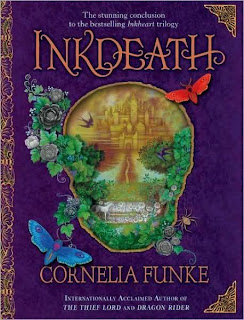
Inkdeath

What to say about Inkdeath? It's been a month since I read it, and though I should have written on it immediately, I, of course, did not. I still think my earlier criticisms of the books stand. She has too many characters. I feel like she could have spent a lifetime developing the characters in this book into a longer series or even multiple series. She has some wonderful ideas, but they are way too condensed.

Wednesday, March 18, 2009

On the Road

A year and a month ago I took off for Savannah, Georgia with two really fabulous people. I didn't really want to go. I didn't have my same sense of adventure at the time that I have now. I had been plotting all week about how to get out of it. I would be leaving my two children with my mom and my sister for three nights and four days. I was fairly recently separated, and I just wasn't in the mood for fun. But for all that, I think I shall never have a similar experience again. I was so shocked to have such an amazing time. Every moment there was new in a way that can probably never be repeated. And 100% honestly I did nothing illegal or even immoral (in my twisted sense of morality anyway) while I was there. No drugs (just a lot of alcohol) and no sex.

In any case, that trip birthed what we now call "the burning roman candle club." It was named a few weeks later by one of our number for the lines in Jack Kerouac's On the Road:

"the only people for me are the mad ones, the ones who are mad to live, mad to talk, mad to be saved, desirous of everything at the same time, the ones who never yawn or say a commonplace thing, but burn, burn, burn like fabulous yellow roman candles exploding like spiders across the stars and in the middle you see the blue centerlight pop and everybody goes 'Awww!'" (Kerouac 5-6).

Of course we came back from Savannah and dived right back into our normal (or not so normal) lives as graduate students at ASU. I had comprehensive exams to study for and a thesis to write. Kevin was bumming around Boone, much the same way he is now; although, I hear he's quit drinking, and Elitza was busy teaching and studying much the same as I was. My life would never be quite the same, and that was mostly because I decided I deserved a little fun before I got old. But I promised myself I would eventually read the book from which these lines came. And so I have, just tonight.

Amusingly enough, my friend Kamy told me that these lines are immensely popular among the ladies. "They ALL have them on their facebook pages," he tells me. It really doesn't surprise me. The only thing that's unique about any of us is that we are all unique, I suppose. Except when you're reading a book like this where all the characters are both unique and amoral. I say that with the highest sense of regard for Sal Paradise and Dean Moriarty.

There isn't much of a plotline in this book, but more ground is covered than in say, Catcher in the Rye. Still, basically Sal hears about a guy named Dean. They meet up when Dean comes to New York with Mary Lou, his first wife. They become good friends and the rest of the novel is the story of Sal and Dean travelling around together and some separately. They go from New York to Denver to San Francisco, back to New York and even to Mexico. Dean is a completely free spirit, and it's hard not to like him, even though by the end of the book he is a virtual pariah in his social group because he leaves impregnated women behind everywhere he goes. He seems to care for people deeply but is too lost in his own little world to take on any responsibility at all. He takes three wives in the book, and he ends up with the second one. He becomes unreasonably angry with the first because she ends up sleeping with a number of other men. I can't imagine why that bothers him, but I guess he feels like these women are really his property once he has them.

Sal, who is a much easier character to get along with, supports Dean until the end, even after being left in Mexico extremely sick. Sal eventually "settles down" in New York, with what he considers a perfect woman for him.

I have seriously mixed reactions to this book. Part of me is soooo jealous that I wasn't born a man or at least hadn't kept myself unburdened long enough to behave like these men did for a while. But, another part of me feels like there is a (yuck) moral in there somewhere about burning the candle at both ends. Their life isn't sustainable. And Dean's biggest problem is that he keeps it up too long. I can totally see why this would be a guy's favorite book though. There is a great freedom in the way the guys behave, and somehow I feel like it should be some people's right. I don't judge Dean as harshly as say Galatea does, but I still feel like his woes were the reasonable consequence for his actions. He lived life hard, which would have been fine, if he could have left women out of it. But once you swear undying love, take marriage vows, and impregnate someone, you're kinda responsible for them. It's a sad truth, and the acceptance of the sad truth is the tragedy of Dean's life. Sal, on the other hand, either does not know who he impregnated along the path or did not actually impregnate anyone, so he escapes the majority of the censure that is heaped upon Dean.

Somehow, though, the whole book feels like an elegy for the way Dean lived his life, as if in some alternate universe it really should have been okay with everyone. And even though Sal settles down in the end, it doesn't feel like some great giving in to societal expectation but rather a rest after a hell of a roller coaster ride. I enjoyed reading this book though. There was relatively no conflict through most of it, but it was really an interesting read, especially for someone trying to understand the male mind.

Thursday, March 12, 2009

The Catcher in the Rye

The Catcher in the Rye is one of those books that sits on your shelf and whenever you told people, "I've never read it," they looked at you with this shocked look, and ask, "Are you really an English major?" So, I caught up with Salinger, and I read The Catcher in the Rye. It was really quite interesting.

When I brought the list of the 100 Best Novels from the Modern Library down to our work room, several of the teachers made the comment that they love J.D. Salinger, but hate Holden Caulfield. They called him "whiny" and "irritating." I do hate ever so much to disagree with my colleagues (they really are excellent people), but I really kinda liked Holden. I felt terribly sorry for him, but I liked him alright. I have to admit that he was overprivileged and spoiled, but he seemed to genuinely dislike cruelty in all its manifestations, and I do too!

My boyfriend is writing his master's thesis on this really depressing film maker and how his films reflect 20th and 21st century masculinity, and I couldn't help but think of all the things he's writing about when I was reading this book. I keep arguing that while the original ideas of what makes a man masculine are really abhorrent and there have been a lot of negative effects on the concept of masculinity because of femininism, there are some genuine positive aspects of the modern man. Holden struggles against a lot of the societal expectations of manhood. The thought of being a "phony" drives him mad, and he would much rather be poor than have to pretend to be something that he's not. Unfortunately, his disgust with the world extends to his academic diligence, and he has failed out of numerous schools in the last few years. He's sixteen, but he's not on his way to graduate any time soon.

The basic plot is ridiculously simple. Holden's been kicked out of Pencey and is to return home when winter break starts on Wednesday. He begins his tale on Saturday night, when he goes to see his professor, fights with his roomates, and leaves the school early on a train. He goes to New York, and he stays in a hotel; he calls up a girl named Sally and takes her to a show. He gets too drunk Sunday night and returns to his old English teacher's house, but not before he visits his sister Phoebe at his parents' place. On Monday, he decides he's going to run away from home, tries to say goodbye to his sister, and when she insists on accompanying him, he changes his mind and goes home. There is no climax or heroic journey: just Holden telling us about a couple of days last winter. But he really does tell us a lot.

One of the reasons I wanted to read this book is because when I worked in the UWC (University Writing Center) last year, one of my clients had written a paper on it for an English course. I'll never forget how she really made me like Holden, even before I had read about him. She kept talking about how he was with the nuns and his thoughts about Jane Gallagher. He really was a sensitive and caring guy, and if any of that was valued by his culture, he might have been alright.

Holden is exactly the kind of guy I wish I could have made friends with when I was younger. He's very intelligent and probably just needs someone fairly intelligent to fawn over him. I was exactly that kind of girl. I always thought I could change somebody's life by making them see their own worth. Anyway, it never worked, but I really do feel bad for Holden.

Monday, March 9, 2009

Inkspell

I can't say that I am entirely enthralled with Ms. Funke's characters here. Inkspell did take place in another world, which is more my kind of thing than Inkheart, but there was still something missing from its pages. I think it might have too many characters. I know that's a weird criticism, but hear me out.

I've read several books where the narrator changes throughout the work. It was the case with parts of Twilight, and it happens in some really great works like The Member of the Wedding. I like getting a fresh perspective on things from a new character's point of view, but in the Inkheart Trilogy, the story is told in the third person, and the focus shifts from one character to another or one group of characters to another without any rhyme or reason except that we need to know what's going on with other people. It's a sort of spatial organization that I'm not all that into. I also think it's a kind of sloppy narrative technique because there are other ways of finding out what other characters have been up to. Story time, flashbacks, etc. So, I still felt a little lost by the end of this book. I felt like I still didn't know any of the characters as well as I would like to, and thereby hadn't really gotten close enough to anyone to want to run out and buy the third book.

Plot wise, we're dealing with similar issues. Yes, Capricorn is dead, but Meggie decides she wants to read herself into what she has christened the "Inkworld" that her mother has told her so much about. As Dustfinger has already been read back home, Farid brings Meggie the piece of paper that took Dustfinger home, and she reads both herself and Farid into the book. We haven't heard the last from Basta or Mortola (obviously) and these two almost interesting villans show back up to seek revenge on Mo and Resa. They are all read back into the book. So, the major portion of the action takes place in "Inkworld," but it's basically the same deal. Basta and Mortola are after Meggie, Mo, and Theresa (Resa). Dustfinger is trying not to die because he knows the original story dictated his death, and Farid is trying to stay as close to Dustfinger as possible. In the "Inkworld" things have gone awry since Capricorn was read out of the book. The Laughing Prince becomes The Prince of Sighs after his son's death, and the Adderhead is preparing to take over the land. The geography of "Inkworld" doesn't seem too vast, so this is a lot of royalty and a lot of government for such a small place. In any case, Fenoglio (read into the story in Inkheart) is trying to fix things by writing and getting Meggie to read aloud. It all gets jumbled and messy, obviously.

What is great about this book? Dustfinger. In the first book, he was simply a quasi-villain. He had sympathy for the heroes, and he had a good motivation for working with the bad guys, but he was a traitor and rather annoying with his constant drive toward his own world. In this book, he is attractive, daring, loving, inventive, brave...you know, all those great hero traits. He's still slightly Byronic--he hasn't been a good father or husband, he loves fire more than people, but he really does show an amazing capacity for self sacrifice. And the self sacrifice culminates in the final scenes. Farid is stabbed in the back by Basta (this did not upset me, but I would be admitting some rather personal prejudices here to explain), and Dustfinger is crushed. Even though he loves his wife, Roxanne (the most beautiful woman in the land), he gives himself to the "white women" (harbingers of death) in order to restore Farid's life. Farid's a whiny baby. Ugh.

So, as if the whole slightly flat characters, spatial organization, and abundance of government didn't put me off enough, she's now killed off one of the most interesting of the flat characters. Needless to say, I didn't run out to by Inkdeath. I'm reading The Catcher in the Rye now, and I'll pick up Inkdeath when I have more money.

Monday, March 2, 2009

Inkheart

I was a junior in college when my mother called me and told me she wanted me to watch the first Harry Potter film with her over Thanksgiving break. I laughed and told her that I could not as I had not read the book. "English majors' rule," I said. The next day I found myself begrudgingly buying the book in a local shop. The rest, as they say, is history. I fell in love with Harry Potter and went so far as to write almost forty pages on the series in my master's thesis. The "English majors' rule" has become somewhat of a joke. I know a lot of English majors who appreciate film as much as books, and almost all of them realize that it's a completely separate medium that needs to be viewed differently than the printed word. Still, when my mother asked me recently to see Inkheart with her, I made a mental note to buy the book. I bought it on Thursday evening, and I finished it just now.

It's no Harry Potter, but it was entertaining. The basic premise (as I'm sure we all know by now from movie trailers) is that Mo can read characters out of books. Nine years before the story takes place, he read Capricorn and Basta out of Inkheart, a fantasy novel by a man named Fenoglio. Capricorn and Basta have set up their evil villian camp in our world and have been trying to catch Mo to have him read more villians out of the book. They like money and inspiring fear in the people around them, especially fear that results in their gain. However, the book felt like cops and robbers while I was reading it. When a story is 534 pages long, I should not be able to summarize ALL the major action in two basic compound sentences, but I can. Capricorn and his men capture Mo, Meggie, Dustfinger, and Elinor, but Dustfinger helps them all escape. Capricorn and his men recapture Meggie and Fenoglio (the author), and they make Meggie read a monster out of a book. It dragged a little at times. The second time we were caught by Capricorn's men, I couldn't help but wonder what we needed the previous capture for...plotwise that is.

I am also complaining because I like my fantasy to take me to another world, and this one did not. Several supernatural things happened, but they all happened here in our own world. Speaking of setting, the setting was weird. The book apparently takes place in Italy, but there is no nod to the language at all. It seems as if everyone in Italy is just running around speaking English. I found it a little disconcerting. I thought it was otherwise well written, and I like the characters (Mo and Meggie, especially, but Elinor also), so I have picked up Inkspell in our school library, and it seems as though we might get another world after all, from the maps at the opening at least.

I think my mom will enjoy the movie though, if that counts for anything! :)